3PL billing software turns the work a warehouse already performs into client invoices. Instead of rebuilding charges by hand at month end, the billing system reads operational data from the warehouse, applies each client's rates, and generates the invoice.
For most third party logistics providers the practical answer is billing built into the WMS rather than a separate tool, because the billable events, receiving, storage and shipping, are recorded there first. PULPO WMS includes client billing in its 3PL plan at $1,290 per month in the US, billed annually, with a reusable billing template for every merchant.
This page explains how the 3PL billing process works, the charges and billing models involved, where revenue leakage happens, and how to move from manual billing processes to an automated billing system.
What is 3PL billing?
3PL billing is how a third party logistics provider charges clients for logistics services: storing goods, handling them, fulfilling orders, and any value added services performed along the way.
It is harder than ordinary invoicing for one reason. Every client has different contract terms, different service levels and a different rate card, and the amount owed changes with actual volume every single billing period. A software business bills the same subscription each month. A 3PL has to price thousands of billable activities across multiple clients, then defend every line if a client asks.
That is why billing software for 3PL operations exists as a category of its own, and why general accounting software cannot do the job alone. Your accounting system is good at issuing an invoice and tracking payment terms. It has no idea how many cubic meters a client occupied last week.
How does the 3PL billing process work?
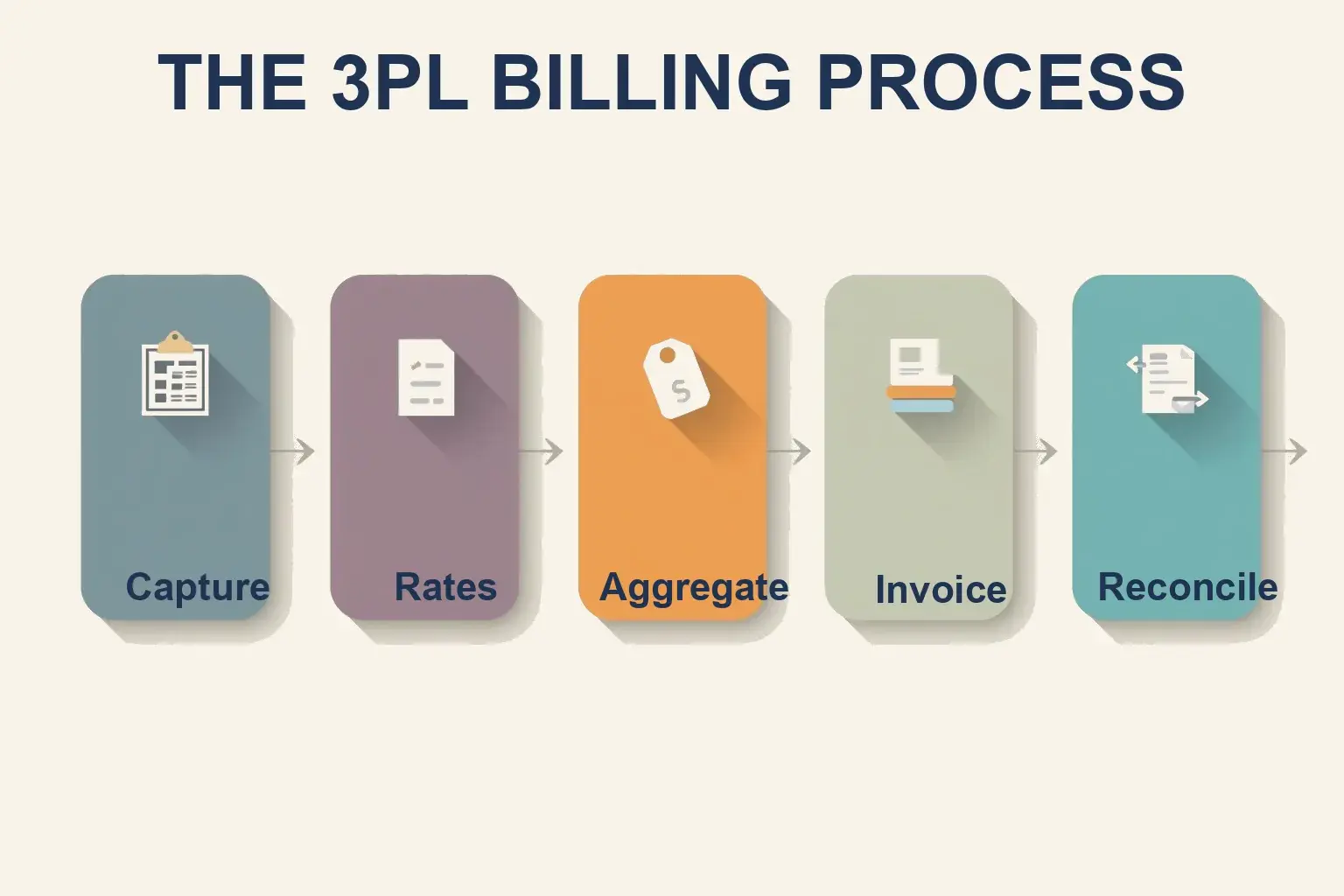
A reliable billing process has five stages.
1. Data collection. Every billable event is captured as the work happens: goods received, positions occupied, orders picked and packed, boxes used, returns processed. Scanning is what makes this trustworthy, because it records service data at the moment of execution instead of relying on manual data entry afterwards.
2. Rate application. Billing rules match each event to the client's agreed price. This is where a per-client billing model lives: tiered storage charges, minimums, surcharges and administrative fees.
3. Aggregation over the billing period. Charges accumulate across the billing cycle, whether that is weekly, twice monthly or monthly. Storage is usually averaged over the period rather than counted once.
4. Invoice generation. The billing engine produces an invoice per client, combining recurring and one-time charges in the same document, and pushes it to the accounting system.
5. Payment and reconciliation. Payment is recorded, exceptions are investigated, and disputed lines are traced back to the operational record that created them.
The fifth stage is the one that separates good billing software from a spreadsheet. When a client challenges a charge, you either have the underlying warehouse record or you have an argument.
Types of charges in 3PL billing
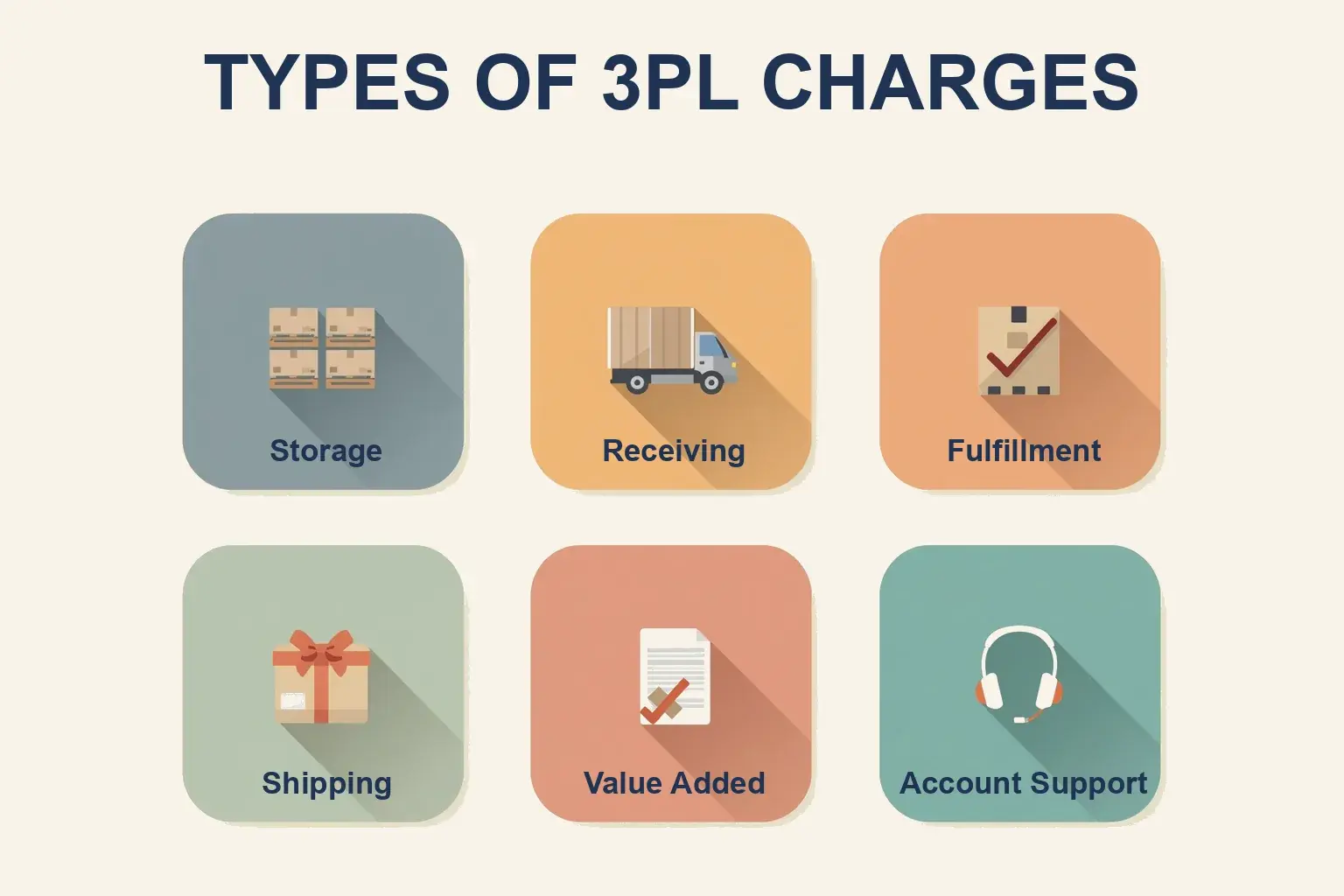
Most agreements draw from the same families of charges.
|
Charge family
|
Typically billed on
|
|
Storage
|
Volume stored, pallet or bin positions occupied, square footage, per zone for special conditions
|
|
Receiving and handling
|
Purchase orders received, units and SKUs accepted or rejected, lots and serials logged, weight or volume
|
|
Order fulfillment
|
Orders picked and packed, units per order, loading units, boxes and packaging consumed
|
|
Transportation and shipping
|
Carrier selection and shipping cost, often passed through with a markup
|
|
Value added services
|
Kitting, labeling, quality checks, reverse logistics and returns processing
|
|
Account support services
|
Account management, reporting, integration maintenance, administrative fees
|
Two details cause most billing disputes. First, storage measured once a month understates a client whose stock peaks mid-cycle, so average occupancy over the billing period is fairer to both sides. Second, work that happens outside the standard workflow, the pallet re-wrap or the emergency equipment hire, is where missed charges accumulate. A good billing system lets you add these as explicit manual lines so they are billed separately rather than absorbed.
Common billing models in 3PL
- Flat rate pricing. One predictable fee per period or per unit. Simple to sell, risky if the client's profile changes.
- Activity-based pricing. Each activity carries its own price. The most accurate reflection of actual costs and the most common model in modern 3PL billing.
- Cost-plus pricing. Your cost to serve plus an agreed margin. Transparent, and it requires that you genuinely know your cost to serve.
- Fixed-variable pricing. A fixed base covering committed space and staff, plus variable charges by volume. Common with larger clients.
- Outcome-based pricing. Tied to performance such as on-time shipping. Attractive to clients and only safe with reliable measurement.
Most providers end up running several models across their client roster. That is fine, provided the billing system can hold different billing rules per client without a spreadsheet for each one.
Common challenges in 3PL billing and invoicing
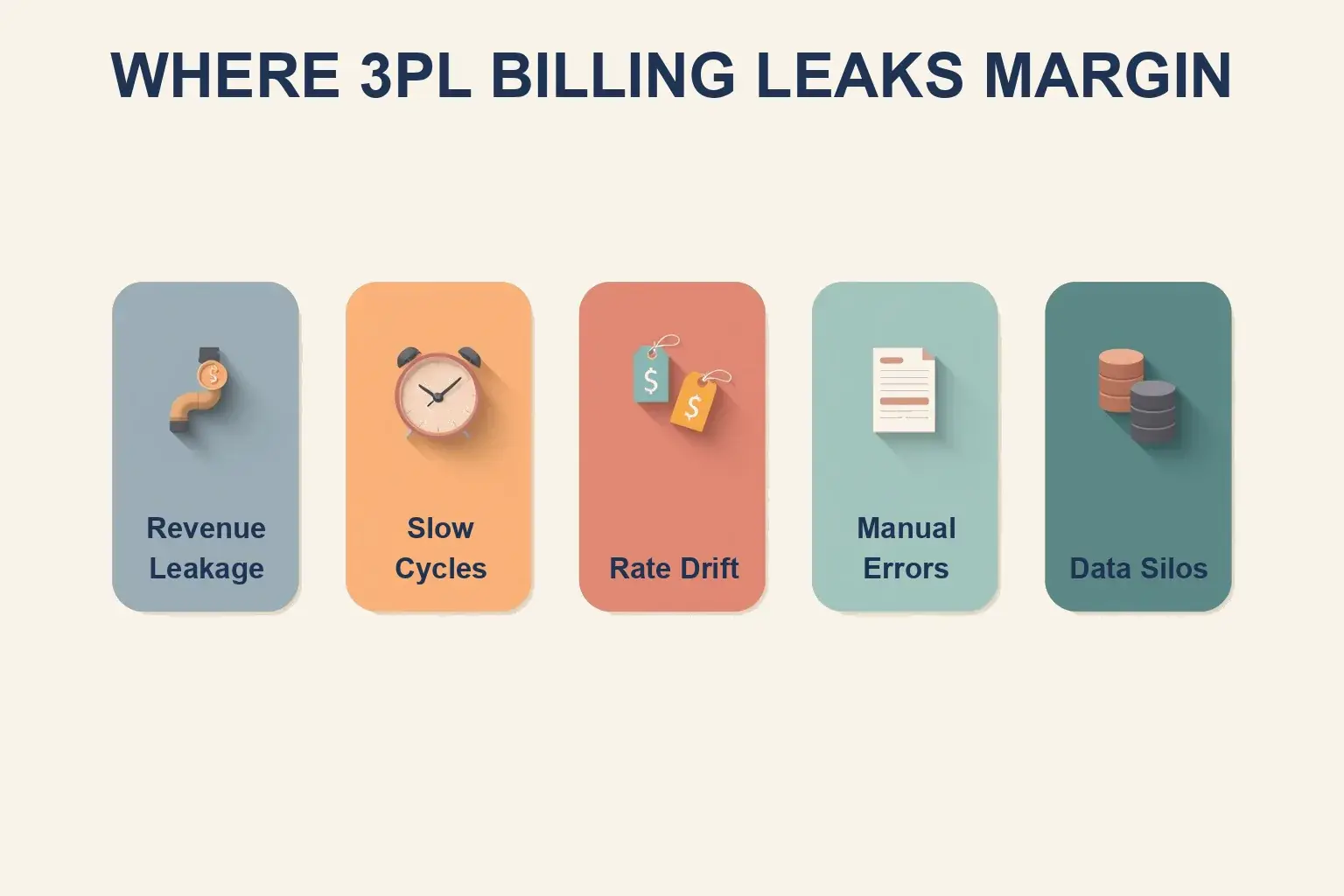
Revenue leakage. Uncaptured monthly shipping charges, unbilled value added services and stale rates are the quiet losses. They are rarely large individually and they compound every cycle.
Slow billing cycles. If invoicing takes a week of manual effort, cash flow suffers and so does financial health. Labor hours spent rebuilding charges are hours nobody bills for.
Inconsistent rate application. When rates live in emails, two team members apply different prices to the same service. Clients notice.
Billing errors from manual processes. Copy-paste between systems produces manual errors that erode trust faster than a price increase.
Disconnected systems. When the WMS, the billing software and the accounting system do not share operational data, reconciliation becomes detective work. Separate data silos are the root cause of most billing disputes.
Key features to look for in 3PL billing software
- Billable events captured automatically from warehouse execution, not entered by hand afterwards
- Per-client rate cards that are reusable each cycle, so there is no risk of using outdated rates
- Storage billing by volume and by occupied positions, averaged across the billing period
- Recurring and one-time charges on the same invoice
- Manual charge lines for custom services the system cannot calculate
- Flexible billing cycles per client
- Accounting integration so invoices and payment terms live in your finance stack
- Real time visibility into accruing charges during peak, before the invoice is issued
- Reporting on billing performance and profitability per client, so you can see cost savings and margin by account rather than in aggregate
How PULPO WMS handles 3PL billing
PULPO WMS records billable activity as part of normal warehouse operations, then builds merchant invoices from those records. Billing is part of the 3PL features included in the 3PL plan, $1,290 per month in the US billed annually, which also includes 5 users, unlimited warehouses, 3 store connections and one Analytics Suite user. Additional users are $225 per month and additional store connections $50 per month.
Billable inputs available in PULPO:
Inbound. Accepted and rejected SKUs, received and accepted quantities, accepted serials and lots, received purchase orders and created incoming goods, weight and volume metrics, and tag-based calculations for differentiated services.
Storage. Average volume stored per cubic meter, average number of occupied warehouse positions, and average occupied positions per zone.
Outbound. Picked and packed sales orders, picked and packed quantities, loading units, volume and weight, packed serials and lots, boxes used, and tag-based outbound calculations.
Anything else. Free Cost lines for charges the WMS does not calculate, such as extra equipment usage, so they appear transparently on the same invoice.
Each merchant keeps its own billing template, reused every cycle, which removes the risk of applying an outdated rate and shortens onboarding for a new client. Because billing, inventory management and order fulfillment sit in the same system, finance and the warehouse floor read the same operational data, and a disputed line can be traced back to the scan that created it. The plan carries a 60-day money-back guarantee.
How to implement an automated billing system
- Analyze your current billing process. Document how each client is charged today, including the exceptions living in someone's inbox.
- Define your billing parameters. Rate cards, billing cycles, minimums and the treatment of value added services.
- Choose where billing lives. Inside the WMS if your billable events originate there, which is the case for most ecommerce fulfillment operations.
- Integrate with your accounting system so invoices and payments do not need re-entry.
- Run in parallel for one cycle. Produce invoices both ways and compare line by line. This is the step most providers skip and the one that finds the gaps.
- Train the team, including warehouse staff, because billing accuracy now depends on work being scanned correctly.
- Monitor and optimize. Review margin per client quarterly and reprice the accounts that consume more service than they pay for.
Frequently asked questions
What is billing automation?Billing automation generates invoices from system-recorded activity instead of manual entry. In logistics it means the warehouse management system passes operational data to the billing engine, which applies rates and produces the invoice with no rekeying.
What are 3PL charges?Storage, receiving and handling, order fulfillment, transportation, value added services and account support. Most providers combine a storage charge with activity charges per order and unit.
What are the three types of billing?In logistics the practical grouping is flat rate, activity-based and cost-plus. Fixed-variable and outcome-based models are hybrids built from those three.
How much does a 3PL service cost?It is normally quoted per client rather than listed, because the price depends on storage profile, order volume, service levels and any value added services. Expect a storage charge plus activity charges, and ask for a worked example on one month of your own volume. For the software side, most WMS vendors also quote per operation; PULPO WMS publishes its US 3PL plan at $1,290 per month billed annually.
How does 3PL billing software improve efficiency?It removes the month-end rebuild, shortens billing cycles so cash arrives sooner, reduces errors from manual data entry, and captures services that were previously performed and never billed.
What are the disadvantages of 3PL?For the client, less direct control over fulfillment and dependence on another company's systems and service levels. Transparent billing and a client portal are the main ways a provider offsets both concerns.
Is Amazon a 3PL or 4PL?For sellers using Fulfillment by Amazon, Amazon acts as a 3PL. Its wider supply chain services extend toward 4PL by coordinating other providers.
How do I choose the right 3PL billing system?Bring one month of real invoices to the demo and ask the vendor to reproduce them. If the system cannot rebuild an invoice you have already sent, including the awkward manual lines, it will not replace your spreadsheet.
See it on your own numbers
The fastest way to evaluate billing software for a third party logistics operation is to model one real billing period. PULPO WMS offers a product tour covering a review of your logistic processes, cost optimization forecasting and integration with your current software, so you can see how your existing charges would be produced automatically.





-1.png?width=300&name=blog%20image%20(23)-1.png)
